I need a break from dissenting, so I’m going to write about my treasure hunting hobby while listening to some music on random. It looks like I have some good stuff to tickle my ears. Yes, Geocaching is a treasure hunting game without real treasure. There is a lot to it, so I will try to be informative, but brief… well I tried anyway…
Geocaching uses satellite technology via an app on your phone https://www.geocaching.com/play/search or through a GPS receiver available through the company Garmin amongst others. https://www.garmin.com/en-US/ Game players hide geocaches all over the place, and the rest of us go find them using this satellite technology. Once you find it, you sign a log with your geocaching handle verifying the find, you log a message stating your find or adventure leading to the find (for the owner and others to read,) and then you collect some statistics based on those finds. Our handle is the mafiamastiffs2. We usually log with an MM2.
Geocaches come in various sizes. Micro-hides are the smallest. They typically only hold a small log. These type of hides are abundant as they can be concealed from the general public (muggles) quite easily. Small containers are about the size of pill bottle or a small peanut butter jar without the spread. These containers can hold a log and maybe small pieces of swag (treasure.) Swag can be stickers, rings, coins, toys, etc… Then there are regular size containers. These are small ammo-boxes or larger plastic jars. Again it holds a logbook, and some swag and trackables for discovering, trading, and moving along (more later.) Large containers are as advertised. They are substantial in size and require some security from muggles as they can be seen easily. The largest container is a shipping container somewhere in the Kansas City, MO (USA) area. Phone booths and even Outhouses (without the stench) have been used as large containers. The larger the cache container the more creative it can be. Next up is the “Other” container. This can be almost anything. An electrical plate stuck to an electric box for example with magnets. It could be a decoy animal perched in a tree. I’ve even seen homemade containers out of duct tape slid in the crevice between stones. “Others” can be challenging at times. The final cache style is the “Virtual” The virtual cache container does not exist, but in order to claim a virtual you have to verify information with the cache owner. Virtuals can be as easy as a picture taken with an object to an extensive set of questions regarding a landmark. It all depends on what the hider wants.
Trackables are imprinted pieces of metal that have a code on them. Cachers send them out hoping to see the trackables venture out on a journey and meet new people. The picture below is a small trackable that we have in our possession. This is Pepe the pet skunk. My wife wants a pet skunk. This is it. It can be discovered by geocachers (finders) at events (more later) we attend.
.
Types of caches in the game of geocaching are: Traditionals, Mystery, Multi-caches, Letterboxes, Wherigos, Virtuals, Webcams, Earth Caches, Adventure Labs, and Events. Traditional caches are a cache that requires no extra effort to find. You search for the cache at the coordinates offered on the page. Mystery caches require one to solve a puzzle to receive the final coordinates. This could be a riddle, or a layered puzzle requiring boolean searches or high quantum mathematics. Multi-caches require finding multiple containers to determine where the final is to sign the log. These can have 2-20 steps pending the hiders difficulty. Letterboxes sometimes have a little puzzle, but they are called letterboxes for the stamp that is in the cache. Wherigos require one to wander around and determine the cache location using a special app that works separately from the geocaching app. Virtual, Webcam, Earth Caches, and Adventure Labs do not have containers. These require information to claim the find. For a webcam you need to submit a picture of yourself from the webcams page to claim the find. Earth caches require some scientific knowledge to be shared. Adventure Labs and Virtual tend to be the easiest, but there are some more difficult ones out there as these require some simple answers to questions about the location.
Events receive their own paragraph. Events include: CITO (Cache In, Trash Out,) Community Celebrations, Block Parties, Mega-Events, Giga-Events, or if you just like to meet your geocaching friends you can have a plain old meet and greet at the neighborhood restaurant. Events are the social fun of geocaching. It is fun to meet people from around the state, region, or world pending how far one travels. It is also a great place to discover, trade, and move along trackables to other geocachers. We met some geocachers in Texas a couple of years ago and it was fun to share stories with one another regarding the hobby.
Geocaching has numerous statistics. This is our own personal scorecard of our cache finding progress. Competition is up to the game player. Most of us just enjoy pursuing goals around these statistics. Everyone plays the game how they want to. Here are some statistics:
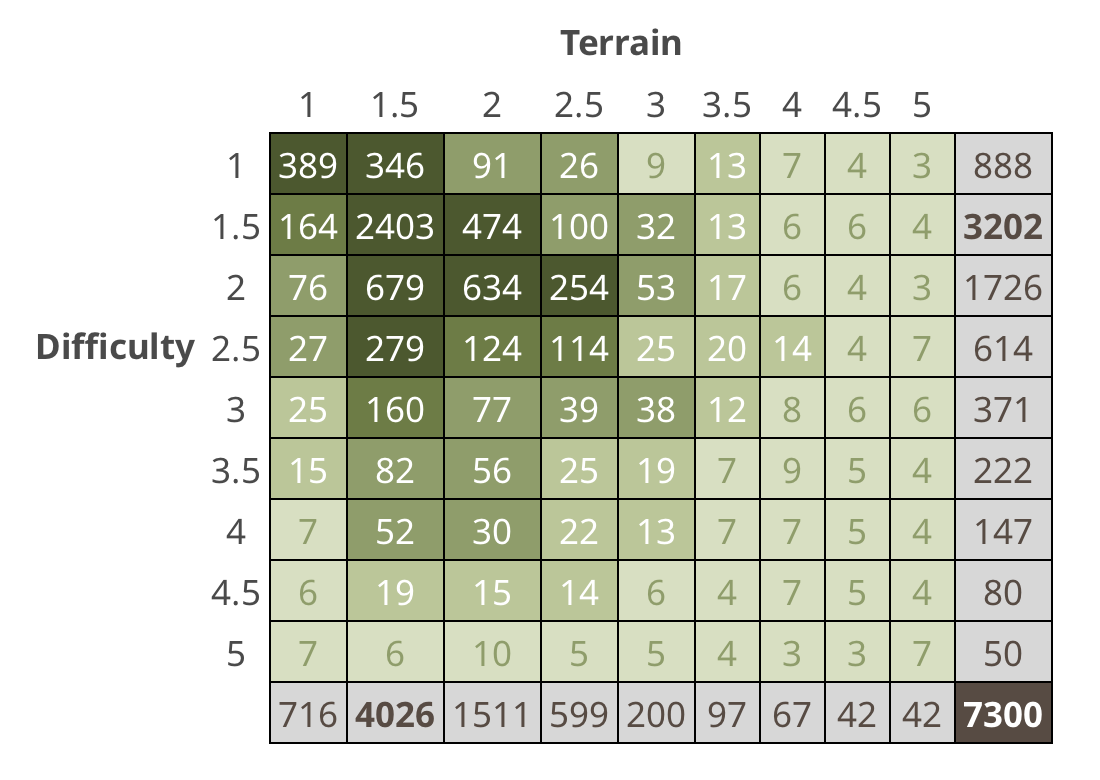
The chart above is a fizzy grid of the difficulty and terrains of caches that are hidden. Difficulty and Terrain 1 is the easiest and Difficulty and Terrain 5 is the most difficult. The ratings are determined by the cache hider. My wife and I cache together, and this is our current fizzy grid. As you can see we have more caches in the upper left and fewer on the right side. The higher terrain ones are a bit more difficult. They require climbing or steep hiking. The hides are dubious, hidden in crevices, or in tree knots, or blend in perfectly with the surroundings. I’m thankful to have some assistance from my teenage children from time to time.
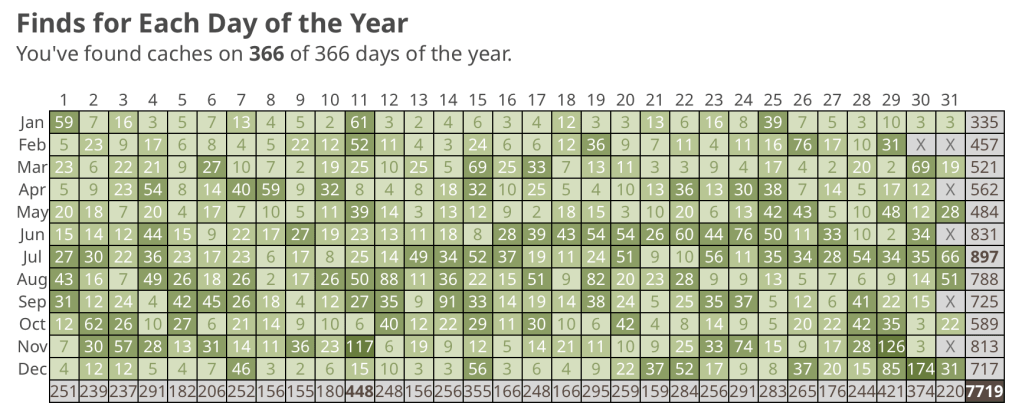
This is our calendar grid. We have found caches on everyday of the year. You may notice the total is different than our fizzy grid. Adventure Labs do not count toward the fizzy grid.
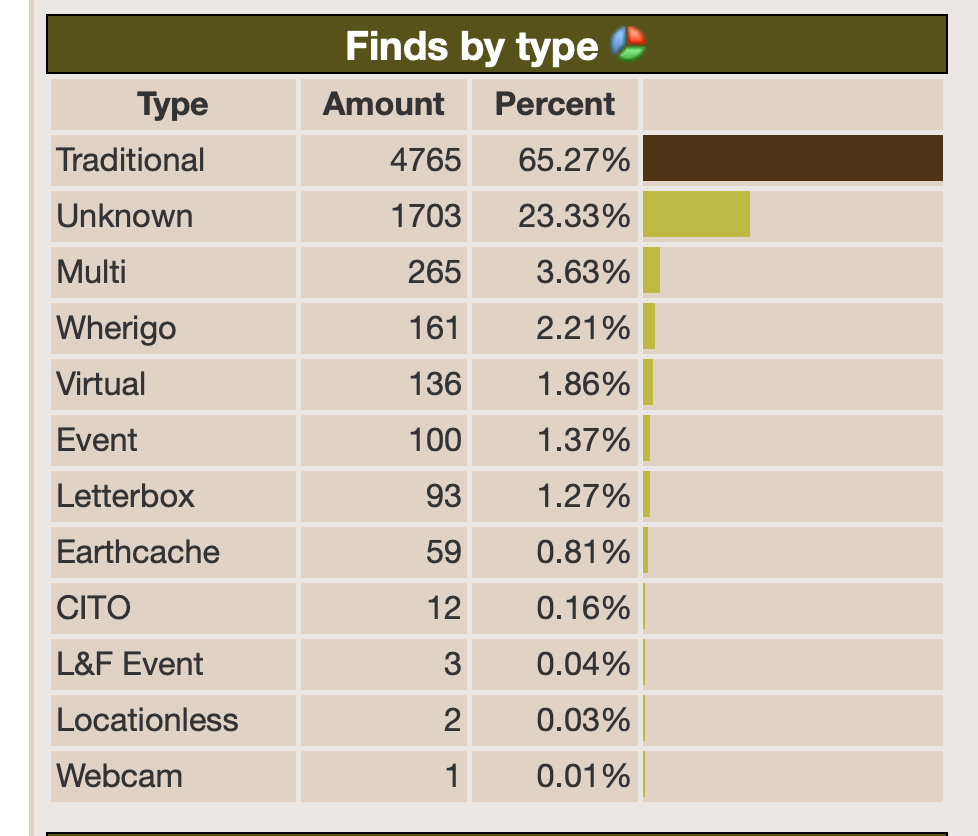
Here are the number of finds by type. Essentially there are hundreds of different stats for one to analyze. Geocaching has been going on since May of 2000. You can fill a jasmer grid with finds that were hidden in every month since May 2000. The oldest surviving geocache is in rural Kansas. It is called Mingo. The cache designation is GC30. The oldest Letterbox is in Illinois. Slices of Quince‘s designation is GC61F. We pay a small fee to operate the geocaching app and the stats are taken care of by some pretty amazing computer techs. All in the name of fun.
Why geocaching? There is always something new to find around the next corner. Geocachers will hide caches at the spots no one ever pays attention to. I thought I had been to every spot in Whiteside County, Illinois where I grew up. A geocacher took me to a bridge I did not know existed in Whiteside County. It had been stricken from the maps for traveling, but the bridge was still there 60 years after it was deemed unworthy of travel. Some people enjoy gathering or chasing numbers. There are geocachers with tens of thousands of finds. There are even a few with hundreds of thousands of finds. It can even help you remember where you went.
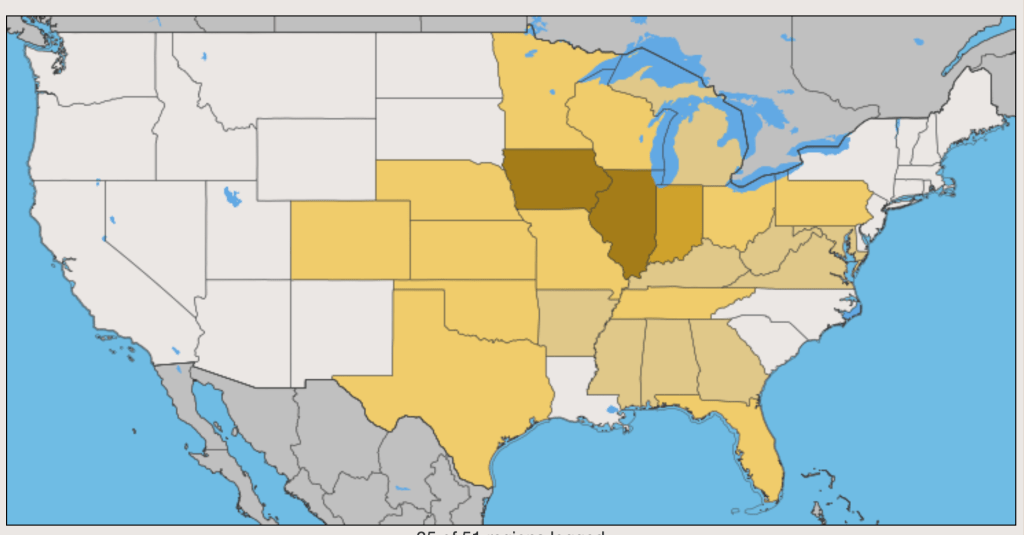
Each state is a memory of an event, a cache, an experience. My wife found the highest cache (elevation) in Colorado while I was in a conference about Teaching children with Trauma. We saw Shohei Ohtani hit a homer at Coors Field after the conference was over. In Florida we found a sea level elevation cache on the beach we got married on. We found the oldest caches in Kansas, Nebraska, Indiana, Missouri, and D.C. It really helps us remember the journey to each destination. We signed the gate at Elvis Presley’s Graceland the same day we found the Letterbox at his Birthplace in Tupelo, MS. We found a cache in President Carter’s family cemetery in Plains, GA. Caching has been a journal of sorts for our travels in our relationship since 2017.
Then there is the hiding part of the game. Hiding is the whole reason the game exists. We have over 200 hides with quite a few now archived as we moved an hour East from our earliest hides. There are geocachers who have hid thousands of caches over the years.
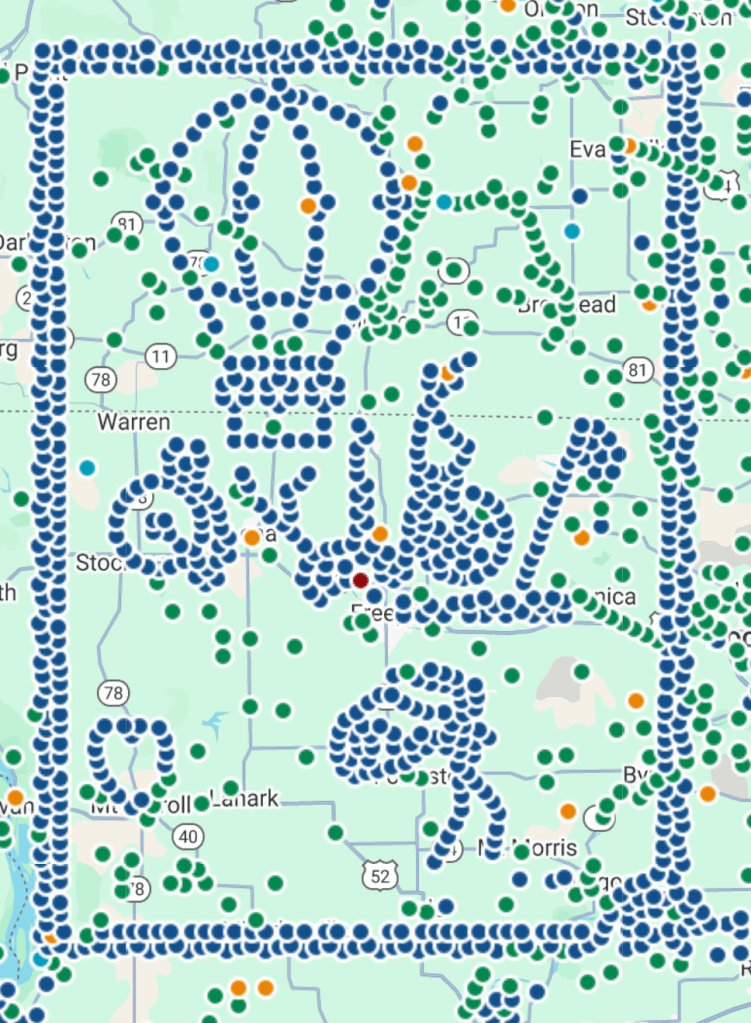
This is an area of eight counties in NW Illinois and SW Wisconsin. Each dot is a cache essentially (Green-traditional, Orange-multicache, Blue-Mystery, Wherigo, Maroon-Event.) There are a dedicated group of geocachers on the far west suburbs of Chicago that wanted to create the Largest Geocaching Art. This is called the Penny Farthing Art. There are well over 1500 hides in this art… and that blank space will be filled… stay tuned… They are hard at work, and they are doing this on their own dime. No one pays us for hiding… We do it for fun!!!
I love this game. It is Worldwide. There are caches in Antartica if you wish to travel ten’s of thousands of miles to get that seventh continent. All you have to do is have the app and a good satellite connection to find the caches and start your adventure. It is great therapy for the cluttered mind, and marvelous exercise if you like walking (hiking,) riding a bike or climbing trees. We don’t skydive, parasail, or shoot weapons. Instead we geocache… What’s your adventure? What makes you go???? Enjoy…
If you have a question regarding geocaching feel free to comment via word press or facebook. I am more than happy to go into more detail for you.
 I Dissent (and other ramblings)
Leave a comment